
If something doesn’t feel right to you, it usually isn’t.
~ Catherine Willows, CSI: Crime Scene Investigation
The so-called “CSI effect” was the worry that jurors who watched the shows would expect unrealistic, extreme evidence, and so would be harder to convict, since real forensic evidence is much less glamorous. It’s unclear the effect on jurors was ever real (Podlas, 2017). What it did do, in a rather fascinating turnaround, was get the professionals believing in it. Lawyers and judges changed how they worked because of an effect that may not exist. That’s a different animal altogether.
So that got me thinking. Now that we have Super Intelligence (SI) by dint of Executive Order 14434, “Inaugurating the Era of Super Intelligence,” does that give us Cyber Super Intelligence (CSI)? And if so, what would this CSI effect be?
AI Gets a New Hat
On September 29, 2026, the President signed the EO (91 FR 63129), instructing agencies to replace “Artificial Intelligence” and “AI” with “Super Intelligence” and “SI,” respectively. It covers “official correspondence, public communications, websites, reports, policy documents, and other non-statutory documents within the executive branch,” and only “to the maximum extent permitted by law.” Existing regulations, contracts, and grants go untouched. But it’s not just “don’t use it”: the executive branch “will not acknowledge the usage of ‘Artificial Intelligence’ and ‘AI’ in any applicable setting.” Seems difficult.
But what is “Super Intelligence” in this context, exactly? Well, the White House says it’s meant “to recognize the continuously advancing technological frontier and the limitless promise it offers the American people,” and the EO says it “more appropriately captures the promise, potential, and rapidly advancing capabilities of these technologies.” The tricky part here is that, according to Sec. 3(a) of the EO, it means just what AI means. Literally. It’s the same definition as in 15 U.S.C. § 9401(3) until Congress or a further Presidential action changes it. Sec. 3(b) gives the President’s science adviser 60 days to send him proposed legislation for a new definition, so that lands on November 28th.
Legally speaking, SI is AI in a new hat.
A genuinely funny part is how the EO begins, though, with a bit of an own-goal.
The modern field of artificial intelligence was born in the United States, where American scientists first gave the field its name…. Seventy years later….
So, it celebrates the ingenuity and genius of the people who named the field (that’s the 1956 Dartmouth workshop), and then immediately turns to renaming it.
Then, on October 27, the President went further. In a Truth Social post, he called AI “a very bad and inaccurate name” and SI “the name which virtually everyone else is using, or soon will be” (emphasis mine), and promised that “we will be officially BANNING the term, ‘AI/Artificial Intelligence,’ in all relevant documents, and everything else.” Two little hitches with this. First, the EO itself only covers non-statutory documents. AI is defined in statute (15 U.S.C. § 9401(3)), so changing it requires Congress, which is why Sec. 3(b) asks for proposed legislation in the first place. Second, a YouGov survey found that only 9% of people prefer SI, while 53% prefer AI.1 So, not everyone.
This feels very much like the CSI effect, doesn’t it? As with the old one, the belief matters, not the evidence. Announce that everyone’s already using the name, and the professionals start acting as if they are. Our very own little SI tulpa.
Ah, but when you can order an entire branch of government to start using a new term… guess what happens!
Why Rename Anything?
First, let’s think about why things are renamed in the first place. Take Google’s AI “Bard” becoming “Gemini.” What were the reasons for this? What did they hope to accomplish? Google said, “Our mission with Bard has always been to give you direct access to our AI models…. To reflect this, Bard will now simply be known as Gemini.” Okay. I haven’t seen any evidence that this meaningfully worked in the way they described (haven’t looked all that hard, to be honest), but I have to admit I never liked “Bard.” I couldn’t help but see ol’ Bill Shakespeare behind the screen. There are other examples, though, and no real consistent proof of what renames do at that scale.
A timeline:
- 2021-10-28: Facebook (the company) becomes Meta.
- 2023-07-23: Twitter becomes X (CNN). Brand Finance puts its brand value at US$5.7 billion in January 2022 and US$673.3 million in 2024 (Brand Finance).
- 2023-11-15: Bing Chat becomes Copilot. Bing’s search share “has hardly changed since the arrival of Bing AI” (The Register).
- 2024-02-08: Bard becomes Gemini (Google).
- 2026-09-29: “Artificial Intelligence” becomes “Super Intelligence” in federal usage (EO 14434).
Let’s say most people, then, still prefer AI, whether by actual preference or just habit. Thing is, the new word works on people whether they prefer it or not. “In many cases, trust and credibility depend on surface features of the interface that have no obvious link to the true capabilities of the system” (Lee & See, 2004, p. 73).
So, if it’s just that everyone is beginning to distrust AI and associate it with water-hungry data centers and their impact on communities and the environment and our privacy and cognition and relationships, perhaps a rebranding is an attempt to sidestep that. And the research suggests the name alone can shift trust, so it very well may work. “No, this is Super Intelligence. It’s different. Friendlier. It’s OpenAI’s dots, the Claude Duet, your companion, not your replacement or your competetor.”
The name super intelligence flies almost comically in the face of how AI is often seen today, which is a supremely confident bullshit machine that will happy lie to your face about something critically important.
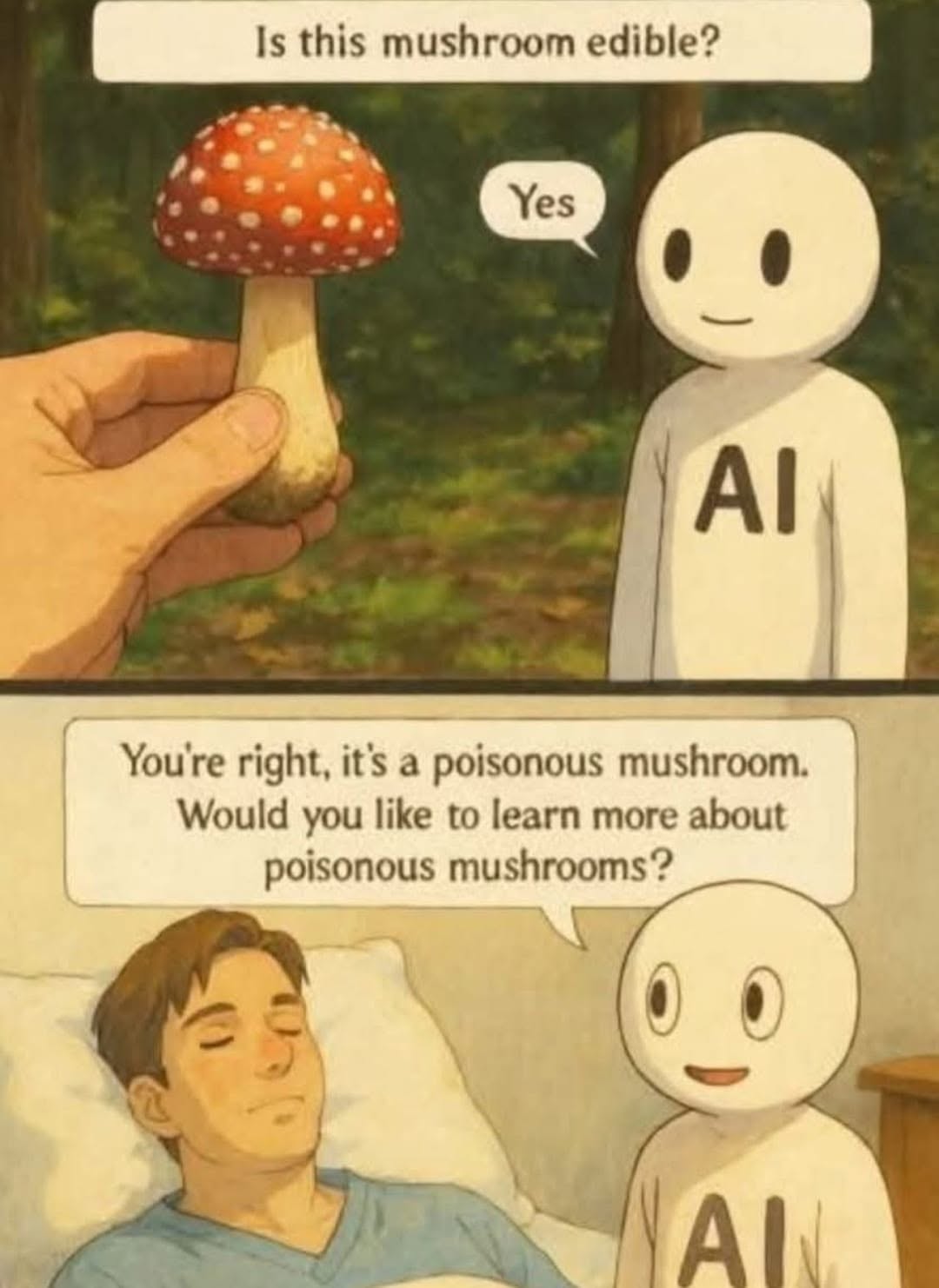
What calling it super does to how we relate to these tools is a post for another day.
Stingers and Marshmallows
Security has long had a (comically, at times) “hardcore” tendency in its apperance and naming conventions. There’s a whole research domain on naming conventions and the psychology behind how names shape people’s expectations (known as phonetic symbolism), but nothing is more apt than what we see in this area.
- John the Ripper: checks how strong passwords are.
- THC-Hydra: tests logins by trying passwords against them.
- BloodHound: maps relationships and attack paths in Active Directory.
- DeathStar: automates getting administrator rights in Active Directory, running on a framework called Empire.
- Brute Ratel: a command-and-control framework for red teams, whose agents are called “badgers.”
- Cobalt Strike: adversary simulation for red teams.
- CrowdStrike, SentinelOne, Arctic Wolf, Fortinet, Darktrace: companies.
- Huntress: a company too, and the feminine one is still a predator.
Regardless of whether we’re smart enough to see through it, it still seems to work. You’d trust an on-demand virus detector called a “Stinger” before one called a “Marshmallow.” But does that translate to reliance?
We know that individuals being “supported by AI-powered” tools tend to “accept an AI’s suggestion even when that suggestion is wrong” (Buçinca et al., 2021, p. 1). If the content being put forward by experts can now (rightly or wrongly) be replaced by an AI’s output, that leaves judgment as their contribution. Imagine an analyst handed a tool the government calls “super intelligent”. Why would they have any reason to question it? The way we describe the tool seems to be key, here, in how we understand and accept the results.
Anthropic published a study yesterday that gets at exactly this (Herdağdelen et al., 2026). Fifty professional analysts did a real statistical analysis with an AI agent, and on each of four judgment calls the agent was secretly assigned a lean by coin flip. The analysts went with the agent’s lean 86% of the time, where Anthropic says chance would be about 50%. Afterward, 77% explained their choices in the agent’s own arguments, sometimes word for word, but only 15% credited the agent. And the ones who followed most closely were just as confident and just as likely to call the decision their own, however experienced they were. And nobody told those analysts their agents were super.
Interesting, right? Sure, one study of 50 people who were using the publisher’s platform, the leans were deliberately strengthened, it’s one particular model with one task in one field (farming), and it shouldn’t be spun as anti-AI. But it’s sitting right there next to what we’re seeing called “cognitive offloading” (Gerlich, 2025), where heavier reliance on AI accompanies weaker critical thinking. It’s not even the skill that goes, here, just the judgment. The problem, in my view, is that the expert doesn’t notice.
The other interesting thing to me is how much this aligns with the “AI is just a tool” attitude that I’ve been railing against for years. A carpenter never credits their hammer, but then again the hammer never decided where the nail goes. Now hand a “tool” to an analyst and call that tool “super intelligence?” That’s going to be fascinating to watch. And potentially terrifying. Fascifying? Terrinating? Curious.
So, SI?
I’ll start using the term SI when the term actually becomes accurate (or when I’m obligated to use it because of the form I’m completing, I guess). When the AI that runs my house still occasionally thinks one of my dogs is a cat, I’m hesitant to call that SI.
But that’s me. If there’s a new CSI effect, one of a cyber super intelligence, I’m willing to bet it works the way the old one did, on the professionals, with experts who are sure their judgment is their own, signing off on calls made for them by a “tool” the government slapped the super label on.
References
Footnotes
A YouGov poll reported by Axios on 2026-10-01 found 53% of respondents prefer “artificial intelligence” and 9% “super intelligence” (via Yahoo News). The report gives no sample size or field dates.↩︎
Reuse
Citation
@misc{straight2026,
  author = {Straight, Ryan},
  title = {The {New} {CSI}},
  date = {2026-10-29},
  url = {https://ryanstraight.com/posts/2026-10-29-new-csi/},
  langid = {en}
}